Autonomous Agricultural Drones: What They Can Do for Your Farm
@jgitj6wtcd
October 8, 2026 · 8 min read
From Novelty to Necessity
A few years ago, I watched a neighbour walk his winter wheat with a scouting notebook, stopping every few metres to check leaf colour and guess at nitrogen levels. Last season, he did the same job from the farm track, with a drone buzzing over the field in a systematic grid. The difference was not just speed. The data he collected told him exactly which parts of the field needed more fertiliser and which would waste it. That is the quiet revolution happening in UK agriculture, and at its centre are autonomous agricultural drones.
These machines are no longer experimental gadgets for tech enthusiasts. They have become practical tools for arable farmers, grassland managers, and even orchard growers. The key word is "autonomous." Modern systems can plan their own flight paths over a field, avoid obstacles, and return to a landing point without constant joystick input. The pilot sets the boundaries and the job parameters, then steps back and supervises. That shift from manual remote control to autopilot changes what is possible on a working farm.
What Makes a Drone "Autonomous"?
True autonomy in agricultural drones is not just about having a GPS module. It is a combination of hardware and software that lets the machine make decisions in the field. The flight controller uses a Global Positioning System receiver, but a standard GPS signal can be off by a metre or two. That is fine for taking pretty pictures, but not for precise application of inputs. This is where RTK comes in. Real-time kinematic positioning uses a fixed base station to correct the drone's position to within a couple of centimetres. With RTK, the drone knows exactly where it is relative to the crop rows, which is essential for variable rate application.
Variable rate application is the practice of adjusting the amount of seed, fertiliser, or pesticide based on the needs of specific zones within a field. Instead of spreading a uniform rate across the whole field, the drone reads a prescription map and changes its output on the fly. This is where the real savings appear. One of my clients reduced his nitrogen use by nearly a fifth on a 40-hectare field of oilseed rape, simply by targeting the areas that showed nitrogen stress in the sensor data.
To build those prescription maps, you need good eyes in the sky. Multispectral imaging captures light in several bands, including near-infrared, which is invisible to the human eye. By analysing these bands, the drone can calculate the Normalised Difference Vegetation Index, or NDVI. This index is a reliable indicator of plant vigour and health. Areas with low NDVI values stand out clearly, and the grower can investigate whether the cause is drought, disease, or nutrient deficiency. Crop health monitoring with multispectral cameras has become a standard service for many drone operators, and it is often the first step toward a variable rate application plan.
Spreading and Spraying from the Air
The most visible use of autonomous agricultural drones is in the application of inputs. Seeding, fertiliser spreading, and pesticide spraying can all be done from the air, and each comes with its own set of considerations.
Seeding with a drone is particularly useful in wet conditions when tractors would cause compaction or get stuck. I have seen a drone sow a cover crop into standing maize stubble, something that would have been impossible with a conventional drill that late in the season. The drone flies low over the field, dropping seeds in a controlled pattern. The payload capacity of these machines is limited compared to a tractor-drawn drill, but for small fields, awkward corners, or late-season work, it is a genuine alternative.
Fertiliser spreading from a drone is a matter of precise placement. Granules are released through a spinning disc or a pneumatic system, and the spread width is carefully calibrated. Because the drone flies close to the crop canopy, there is less drift than you might expect. This is especially useful for top-dressing nitrogen in spring when the ground is still soft. A drone can cover a field while a tractor would churn up the headlands.
Pesticide spraying is where the technology gets really interesting, but also where the regulations bite hardest. The drone carries a tank and a set of nozzles, and it can apply a fine mist over the crop. The advantage is that the drone can work in steep terrain, in muddy conditions, or in fields surrounded by hedges and trees that would block a full-size sprayer. The downside is the limited payload and the need for careful battery management. You are not going to spray 50 hectares in one flight. You will need to swap batteries and refill the tank multiple times, which is why the best operators plan their logistics carefully.
The Machines That Make It Happen
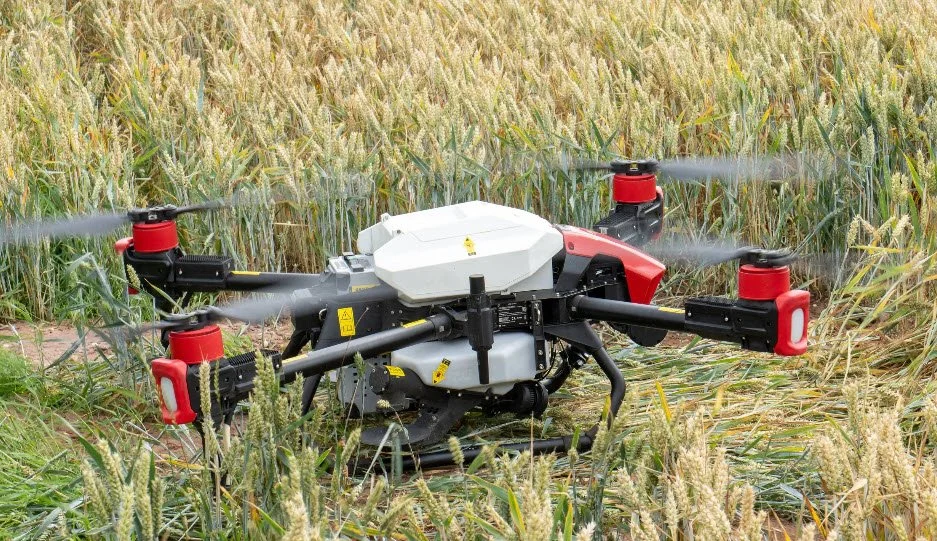
Two names dominate the market in the UK and beyond: DJI Agras and XAG. DJI Agras models, such as the T30 and T40, have become common sights on progressive farms. They offer large payload capacities, rugged construction, and user-friendly software. XAG is a strong competitor, especially in Asia, but its presence in the UK is growing. Both platforms support RTK, autonomous flight, and variable rate application, and both have proven themselves in real-world conditions.
What sets these machines apart from consumer drones is their durability and their ability to carry serious weight. A spraying drone might carry 20 to 40 litres of liquid, while a spreading drone can hold 40 to 50 kilograms of seed or fertiliser. That is not a toy. That is a working machine that demands respect and proper training. The DJI Agras T40, for example, has a payload capacity of 50 kilograms, which means it can cover a considerable area per sortie, but it also means the operator must be aware of the risks associated with heavy lifting and spinning blades.
Regulations and the Human Factor
It would be easy to think that autonomous agricultural drones mean you can set them off and forget about them. That is not how it works, at least not under current UK rules. The UK Civil Aviation Authority requires that any commercial drone operation be conducted by a certified drone operator. That means you need to hold a valid qualification, typically the A2 Certificate of Operational Competence or a General Visual Line of Sight certificate, depending on the type of operation. For operations that go beyond visual line of sight, you need special permission, and those BVLOS flights are still rare, though the CAA is actively working on a framework to enable them safely.
The practical upshot is that you will not be flying a drone over a field you cannot see. You need to maintain visual contact with the aircraft at all times, unless you have a specific BVLOS approval. That limits the range of a single flight, but it also keeps the operation safe and legal. A good operator will plan the flight path so that the drone stays within a reasonable distance, and they will use the drone's sensors to avoid trees, power lines, and buildings.
Another consideration is airspace. You cannot fly your drone in controlled airspace without permission, and you must respect the rules around airports and military zones. The CAA provides guidance on this, and most modern drones have built-in geofencing that prevents them from entering restricted areas. But the operator is ultimately responsible for checking the airspace before every flight.
Swarm Technology and the Future
One of the most exciting developments is swarm technology, where multiple drones work together on the same field. Instead of one drone covering a large area, a swarm of smaller drones can divide the field and operate in unison, each following its own pre-programmed path. This increases the effective coverage rate without needing a single massive machine. Swarms are still in their early days, especially in the UK, but the potential is clear. Imagine a fleet of five drones spreading fertiliser across a 20-hectare field in the time it takes one drone to do a quarter of that.
But swarms also present challenges. They require sophisticated coordination software and reliable communication between the drones. They also multiply the risk if something goes wrong, so the safety case is more complex. Still, the pioneers in this area are making steady progress, and it is likely we will see more swarm operations in the next few years, particularly for tasks like seeding and spraying where speed is of the essence.
Making the Call
So, should you invest in an autonomous agricultural drone for your farm? The answer depends on your scale, your crops, and your willingness to learn a new skill. If you have hundreds of hectares of combinable crops, a drone might not replace your tractor-mounted sprayer, but it can be a valuable tool for spot treatment, for areas that are hard to reach, and for gathering data that helps you make better decisions. If you have a smaller holding, or if you grow high-value crops like fruit or vegetables, the economics can be very attractive.
The key is to start with a clear objective. Do you want to improve crop health monitoring? Are you looking to reduce chemical use through variable rate application? Or do you want to be able to spread slug pellets in wet weather without rutting the field? Once you know what you want to achieve, you can choose the right equipment and the right training. And if you do not want to buy your own drone, there are certified drone operators across the UK who offer these services on a per-hectare basis. They bring the expertise, the insurance, and the CAA permissions, and they can often do the job more efficiently than a farmer who is just starting out.
In the end, autonomous agricultural drones are not a magic solution. They are a tool, like a combine or a sprayer, that requires skill and judgment to use well. But for those who embrace them, they offer a level of precision and efficiency that was unimaginable a decade ago. The future of farming is in the air, and it is already here.